“BLUES EXPLOSION
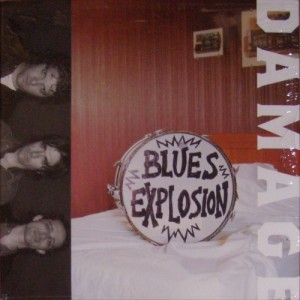
What is new rock? The new album “Damage” by Jon Spencer Blues Explosion, formerly known as Blues Explosion, seems to answer that question. The album doesn’t incorporate any particularly digital elements, nor is it filled with innovative tones, but it has a strange feeling that somehow doesn’t quite fit in the rock genre. The basic bass-less structure of twin guitars, drums, and vocals is impressive, and this time, the addition of talented producers like DJ Shadow, David Holmes, Dan the Automator, and Steve Jordan gives the impression of their sound undergoing diverse chemical changes. Their sound, which blends the roughness unique to rock with the precision of post-processing, sometimes incites the listener, and at other times transports them to a psychedelic paradise. It’s a strange world of anonymity, completely devoid of the ego of guitarists and vocalists that is so common in rock music. To explore the true meaning of this work, we present interviews with Russell Simins, the band member with the most extensive knowledge of engineering, as well as mixing engineer Alan Moulder and producer Dan the Automator.
BLUES EXPLOSION
RUSSELL SIMINS
Interview with Russell Simins
Although there are many producers involved, this is by no means a remix album.
I didn’t have any specific sound in mind, I just kept writing songs for three months.
Please tell us how you decided to change your name to Blues Explosion.
It was Jon who first suggested this, but we felt it was time to move on from our previous name. The three of us have been collaborating with each other for a while now, and the band has evolved, so we felt it was time for a name change. We’ve been feeling really good as a band over the last few years, so it felt like the right time.
Compared to your previous album “Plastic Fang,” which returned to simple rock, this album incorporates elements of abstract and dub. What kind of album were you aiming for this time?
We didn’t have any particular sound we were aiming for. We just spent three months writing a bunch of songs, picked the ones we liked, and had different producers work on each one. It’s a mix of the music we liked at the time, what we responded to, and the sounds we thought were best.
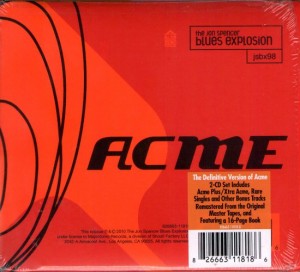
I thought the wide variety of sounds in this album was quite similar to their previous album, “Acme.”
We never thought about it like that. Like I said, we just wrote a bunch of songs and made an album out of them. I think there’s a consistency in every band, but “Acme” is an album that could only have been made at that time, and it’s completely different. We’re evolving. People often compare “Damage” to “Acme” because the songs are stylistically diverse and reflect different sides of the band, both musically and emotionally. I love this album. Just like “Exile on Main Street” encompassed everything the Rolling Stones were, this album encompasses different sides of us. I’m not comparing “Exile on Main Street” to this album, though.
It’s also notable that there are several tracks that don’t feature pace guitar. Furthermore, the absence of bass enhances the kick drum, creating a more raw sound.
My drums are also the tempo! (laughs) Of course, there are songs with tempo, and we’re not insisting on being bassless. It’s just that we don’t have a bassist in this band. In fact, my drums cover a large part of the low notes, and my guitar tone also complements the low notes. We even perform live without a bass.
I recorded a demo in my studio and developed it with producers.
Where did you record it?
I wrote the songs in my private studio in Manhattan. I wrote the songs there, made demos, and started communicating with producers. I gave them the demos and they could decide whether to use them for the final release or re-record them. The songs often changed as we worked on them. Basically, we spent three months writing songs, and then worked with the producers to develop them into the final song.
Did each producer construct the songs in a remix-like way?
No, it’s not. We worked on the songs together with the producer. It’s not a remix album.
For example, what was it like working with DJ Shadow?
Did you?
“Fade Up Low Down” was a unique song that we did together. He came to my studio and we started writing from scratch. He’s a really great guy, and it’s rare that we get along so well with someone we’ve just worked with for the first time. I really love this song.
What about working with David Holmes and Dan the Automator?
Regarding “Spoiled” that I made with David Holmes, so I sent him the original demo, and he sent me a demo with Martina Topley-Bird on vocals, saying, “This is how I want to produce it.” I loved it. Then I asked Dan the Automator to re-record all the parts on “Help These Blues.” Basically, each producer had their own way of doing things.
Computers are not the enemy of bands; they solve all kinds of problems.
In a previous interview with John (May 2002 issue), he said that Russell had become interested in the recording process.
Was it made as part of the project?
Yes, definitely. The reason I wanted a recording studio was so I could work on music whenever I wanted. I love working in a studio. I’m a musician, songwriter, producer, and engineer, but I also wanted to build a private studio so I could focus on writing songs without worrying about time or rental fees. My friend, an engineer, knew the ins and outs of studio know-how, and I learned a lot over time. It also has a live room and lots of great equipment. It’s like my own sound room!
Specifically, what equipment is set up in the studio?
There’s a lot of equipment, but I’ll just list the important ones for now. Recorders include a DIGIDESIGN Pro Tools | 24 Mix Plus, a STUDER 24tr, and an MCI 2tr tape machine, and monitors include a YAMAHA NS-10M and a GENELEC. There’s also a good selection of outboard equipment, including a UREI 1176 with black and silver panels, an EMPIRICAL LABS EL8 Distressor, a NEVE 1073, and an API module.
The songs are great, it’s a full-throttle album, we’re always breaking new ground.
We have a HAMMOND organ and Leslie speakers, a RHODES, a MOOG Minimoog, and most of the drum kit parts are from the 1970s. The snare is from the 1950s. We also have an Akai Professional MPC3000, which we used a lot when DJ Shadow came over.
For this recording, did you use Pro Tools or an analog MTR?
We recorded it on Pro Tools, so everything we played was captured on the computer. It’s like using a computer instead of a tape machine, and Pro Tools is more convenient because you can burn any song you want to a CD and take it home and listen to it.
The sound of this album is rough in a good way. It’s almost analog.
The digital world isn’t a bad place after all, is it?
However, that analog-like texture was only possible because all aspects were excellent: songwriting, instrumentation, performance, sound production, and mixing. The technology brought about by computers is incredibly inspiring. You no longer need an analog multi-track recorder to make great music. All you need is great guitar and drum sounds, tasteful processing, and a talented producer and engineer. There are some things that only analog can do, but the two worlds of digital and analog can co-exist.
The band’s stance is that they are good at technology.
Should we use it for that purpose?
That’s right. Computers are by no means the enemy of a band. On the contrary, they are a tool that can solve a lot of problems. The problem is that a lot of people rely solely on technology. Digital guitars, digital effects, digital processing… they do everything in the computer. But our foundation is live performance, and computers are just one option. We don’t work exclusively in the digital world.
The deep bass sound of the drums, this was due to a microphone placed outside the room.
One of the characteristics of this album is that each song has a different drum sound. How was the mic placement during recording?
We basically kept it basic. We had two Shure SM81s for overheads, two AKG C414s for ambience, and one Neumann U67. We hung the U67s from the ceiling in front, about 3-4 meters away from the kick drum. We used standard dynamic mics for the snare and floor tom, and our go-to AKG D12 for the kick drum. We also sometimes set up mics outside the live room. There’s a kitchen just outside the live room, and there’s a huge stairwell there. We set up mics there and recorded, and got a massive bass sound. It was amazing. It’s said that Led Zeppelin’s “Levy Break” was also recorded with mics on the stairwell, but we weren’t trying to imitate them. At Headley Grainge Studios in England, where they recorded that song, they probably had stereo overhead mics above and below the drum kit, and reinforced the sound with an echo unit. This gives it a very compressed sound, but we were able to use the acoustics to get the biggest, most natural echo sound possible.
Also, what vocal mic did you use? Is there a vocal mic that Jon prefers?
Jon used a variety of microphones. He didn’t record all the vocal tracks in our studio, but as far as I know, he used a U67C414 or a Shure SM57. He also used a Neumann KM86… Neumann microphones are a big hit in our studio. They’re absolutely fantastic.
The KM86 is a great all-around mic that can be used for everything from vocals to guitar amps to room mics.
Did you use a click this time?
Yes, occasionally. A song that uses a click is “Help These Blues,” which I did with Dan. Actually, the original demo was recorded without a click, but when we re-recorded it, Dan requested that we use a click. It was easier to add Dan’s unique touch to the beat later on with a click. In the end, it turned out to be a very strong song for Pete. We also re-recorded “You Been My Baby,” which was produced by David Holmes, using a click, which wasn’t used on the original demo, because it made it easier for him to edit. I’m actually quite good at drumming along with a click.
Jon was also good at playing synths and used a lot of cool instruments.
“Damage” was co-produced and mixed by you and Elegant Too. How did that heavily edited track come about?
In fact, “Damage” was the only song that wasn’t completed at the demo recording stage. I put it together with Elegant Two, based on Jon’s guitar and my drum beat. First, I looped the guitar, and then I looped the drum part as well to create the foundation. Then, I overdubbed the live performance parts on top of that, and this song, which is just over a minute long, was completed. At first glance, it seems like a live track, but if you listen closely, you’ll realize that it was a song that was put together over a long period of time.
Is the booming low kick in this song caused by the microphone you mentioned earlier set up in the stairwell?
Yes, the drum loop on this song was further compressed in the mix and then another live drum was added.
I did do a little processing, but the drum sound really depended on the room. And the most important thing was the way I played! (laughs) The reason Led Zeppelin’s drummer John Bonham’s drumming sound was so great was largely due to the way he played. In the same way, the drums on this song wouldn’t have sounded the way they did if I hadn’t played them. There’s a part in the second half of the song where the beat speeds up, but it was because I played that it had such a rock sound.
You also used Alan Moulder as the mixing engineer for “Mars Arizona,” “Rattling,” and “Blowing My Mind.” Why did you choose him?
We’re friends with the Yeah Yeah Yeahs, and when Alan worked on their album, we listened to the pre- and post-mix versions of their work and loved how distinctive his sound was. The Yeah Yeah Yeahs had really pushed for Alan, and we were familiar with his past work, so we thought he’d be the perfect person to work with. He’s had a long career and has worked on a lot of great albums, most notably My Bloody Valentine’s “Loveless.” He came to Manhattan and worked at Shear Sound Studios.
It seems that Jon uses a KORG Kaoss Pad on “Rattling.” Is that unusual, since we rarely see him with anything other than a guitar?
Not at all. Jon plays a lot of cool instruments. He plays a lot of synths on this album, including “Mars Arizona.” He’s good at playing synths.
The punk attitude gives the album a coherent feel.
Although each song has a different sound color, the album has a sense of unity.
Is this the result of deliberate control?
No, I think it’s because everyone who participated understood the Blues Explosion sound. Everyone we worked with on this album liked us, so they all composed and composed with the Blues Explosion context in mind. David Holmes, Dan the Automator, Steve Jordan, and DJ Shadow all have respect for the music we’re working on, which is why every song sounds like Blues Explosion. They’re not in a different category from us. Each of us has our own sound, but we all belong to the same world. Fortunately, their aesthetics and punk attitude gave the album a sense of coherence. It’s wonderful.
Now that you’ve completed this album, which shows a new direction for rock, do you see more potential in the future: in terms of instrumentation or post-processing? I think both are important. One more than the other. It’s not a question of what’s possible, it just depends on what you want to do. Live instrumentation and processing with good equipment will always be important. It all comes down to guitars, amps, and drums. And processing has always been important. Rock, whatever it is, is about personality: people, guitars, amps, drums, vocals, style. On the other hand, technology has made recording much easier, allowing you to explore more of what you want to do, and making it more convenient in many ways. So I think we’ll continue to see more people placing an emphasis on processing recorded music.
Finally, how do you feel about creating this film?
I love it! It really captures the essence of the Blues Explosion. It’s full throttle and the songs are great. We’re always breaking new ground.”