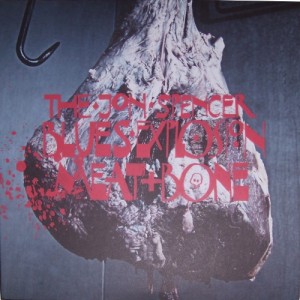
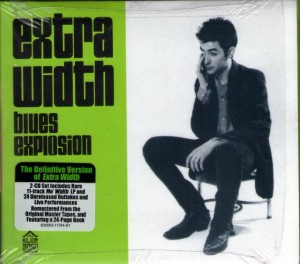
The Jon Spencer Blues Explosion, a bassless trio blasting blues-punk, are back with their first album in eight years, “Meat & Bone.” As the title “meat & bone” suggests, the album is packed with the gimmick-free Jon Spencer sound, featuring the dirty and stimulating guitar work of Jon Spencer (pictured left) and Judah Bauer (right). They’ve also announced their first solo Japan tour since 2004, scheduled for November in Tokyo and Osaka! Let’s jump right into a personal interview with the duo.
Jon Spencer:
First up, we have leader Jon Spencer. We asked him about adding his own name back to the band after removing it from the name on their previous album, the background and concept behind the band’s production, and the equipment he uses to create his aggressive guitar sound.
We wanted to pursue our old-fashioned style and go back to our roots.
As we grow older and become a band I’m proud that this album was made possible because of the long history we’ve had.
I’ve been really looking forward to this. A cool album has arrived. How do you feel about it?
It’s being released in the US tomorrow (September 18th) and I’m really excited about it. I started recording it last October and put in a lot of effort, and it’s a really good album so I’m really proud of it.
Please tell me if there is a reason for leaving such a long interval.
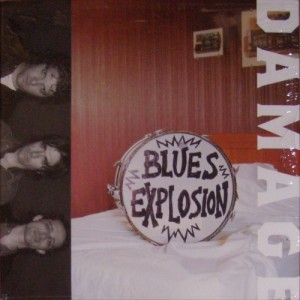
My album Damage came out in 2004, and I toured the world until the following afternoon, then took a long break until 2008. One of the reasons was that I wanted to play with other musicians, and I was in a rockabilly band called Heavy Trash. It seemed like Judah and Russell Simins were also appearing in other projects. That kind of refreshment definitely helped me get into a positive flow.
You’ve probably been asked this many times, but why did you decide to change the band name back to its original?
Two years ago, we reissued our old albums, taking stock of the first 10 years of Pandora’s legacy. We realized that calling ourselves Blues Explosion with “Damage” confused our fans. We’ve reissued the old albums, and decided to keep the same name for the new album, based on sales. However, the dynamics and essence of Pandora remain the same, and it’s still a collaboration between Judah, Russell, and us.
Is this album self-produced?
The three of us recorded, engineered, and produced everything, and we didn’t even aim for guest musicians. Up until now, we would have had someone else play on the album, but we didn’t this time because, while revising our old recordings for the reissue, we felt there was a strength in the old recordings we had just done as a trio. We pursued our old-fashioned style and were mindful of returning to our roots. I think the key to this album is that it was heavily influenced by the music we’d played in the past. We composed the music as we always have, playing together, and we didn’t do anything particularly special or experimental. But it’s not a rehash or a reproduction. It’s who we are now. It’s something we couldn’t have made 10 years ago, and we’re proud of the album we made thanks to our years of experience as a band.
Although it may seem simple, the overall sound is exquisitely “dirty” with various distortions and aftereffects, which is what makes it the John Spencer sound.
I think so. I would like you to give me some distinctive
Is it okay?
We love dirty, raw guitar sounds (laughs). The studio we recorded at this time, Key Club in Michigan, had a lot of old amps, and we liked and used a Heathkit amp a lot. For example, my guitar on “Get Your Pants Off” has a series of square wave fuzz-like sounds, but this was made directly through the amp, and I really like it!
The song that played a leading role in the production of the album was
Do you have it?
“Strange Baby,” “Get Your Pants Off,” and “Black Thoughts” were written early on, so I think that helped determine the direction. When making an album, I prepare and record more material than necessary, and this time I wrote 20 songs and recorded 12 of them (Note: 314 songs recorded in Japan). There were also songs that were removed because they didn’t fit in with the album as a whole. All the songs came together, and I started to think about the clothes and the mix.
After that, I finally started to see the direction I wanted to go in. “Black Mold” has a strong presence as an opening song, and it’s really cool.
It’s true that this is the best opening song. Not only the sound, but the feeling and lyrics are perfect, and it speaks to the theme of the album. But I wasn’t sure where to put the song I was writing, so I decided to bring it in as a result of taking the whole album into consideration.
On “Get Your Pants Off,” you play a boomy, fuzzy, pacey sound. Is that also due to direct amp input?
Exactly. Judah sometimes uses pedals, but I generally record straight into the amp and don’t use distortion or fuzz or anything like that.
We promise to put on a super exciting rock and roll show.
Please tell us what equipment you used for recording.
I used my familiar Japanese guitars (Fujigen) and mainly Heathkit, Kustom and Marshall combos as amps. I tried different things depending on the song, putting the amp in different sized rooms and even recording it in the same room as the drums. It was all about getting a good sound and what suited the song.
Is the Fujigen 2 in good condition? It’s about 50 years old.
This is a guitar from a few years ago.
The pickup went bad so I replaced it, but it’s still in use (lol). I have three guitars that are the same age, but the one I’ve been using for the longest time has been used so much that most of the paint has peeled off. How do you tune your guitar?
Judah plays mostly in regular tuning, and some in Spanish tuning, or open G. That’s what the slides on “Black Mold” and “Bag of Bones” are all about. I always played in drops.
By the way, what is your favorite phrase from Judah’s guitar playing on this album?
When we finished the recording and started dubbing, he showed us some pretty amazing playing. The little licks that intertwine with the main guitar in “Black Thoughts” really made the song cool. He’s not just good at lead sounds, but also sounds that create an atmosphere, like echo or delay, which can really get you going. Of course, his slides are great too, and “Danger” is a good example of that.
So, what is your favorite part of your own playing? When I play solo, I don’t plan things out in advance, but rather I play with a rough idea in mind, with an image of “chaos” or “everything shaking.” On top of that, I try to create something that has something fun and silly in it. It’s okay to make mistakes. In that sense, Zoro from “Get Your Pants Off” is my favorite.
In November, they will perform in Japan for the first time in eight years.
Could you give a message to your fans? We’re all excited to be back in Japan, and more than anything, we’re happy to be able to perform live. We hope you’ll come and experience the Prussian Explosion. We promise to give you the most exciting rock and roll show. We want to have a great time with you all, and we can’t wait to see you soon.
Judah Bauer:
Next up, Jon Spencer’s sound wouldn’t be complete without his guitar! Let’s talk to Judah Bauer, his partner who supports Jon with vintage equipment and an old Telecaster.
I cherish the pure tone that comes from the Telecaster’s unique pickups.
It’s been a while since your last album. What are your thoughts now that it’s finished?
The question is, what will happen next? It’s been a really long time since our last album, so let’s see how the world reacts. Great bands like The Black Keys and The White Stripes have been making waves over the last eight years, bringing attention to the roots of rock. There’s probably a lot of competition, but I think this is a great album, and I’m very happy.
This is your first album in eight years, and I imagine that you have absorbed a wide range of music as a guitarist during that time. Could you please analyze how that influenced your production?
We play a very simple, stripped-down style of music, so it’s hard to say that we’ve had any particular influences. I think the biggest impact we had was when early hip-hop artists like Ice Cube came out. Other than that, we’ve always just listened to and played the music we like, like Link Wray and the Stooges. We’ve checked out new music, but we’ve never actively listened to new music, and we still love early rock and roll and hardcore.
Are you still exploring the bluegrass and country side of playing?
Around the time of Acme, I got a B-Bender guitar and that’s when I got into bluegrass. I learned everything I needed to know. I tried to play a bluegrass lick on “Get Your Pants Off,” but it ended up sounding like a failed attempt (laughs). So I guess you could say I’m actually influenced by more modern music. I want to incorporate everything, but it always ends up sounding dirty. If you want to hear perfection, listen to old records; I want to play with a sound that’s my own.
You have a solid, rich, and fat Telecaster sound. What are the key points you consider when creating your own sound?
I don’t like guitars made after ’66 because it seems to have lost something big. Well, I guess I’m one of those “guitar nerds” (laughs). The Telecaster has a bright tone, so I try not to bring that out too much, but I don’t want to lose the Telecaster feel, so I try to make it a thicker tone. I value the pure tone that comes from that unique pickup, which is different from that of a Les Paul. But the combination of a Fender guitar and a Fender amp
The key is to combine them in a way that works for me. I also use Magnatone amps on this album, and for every song I place microphones on both the front and back of the amp, inverting the phase. This helps create a very dynamic tone. I basically played around with it like that on top of the amp.
Tell us about the equipment you used on the album. I used a ’59 Fender Deluxe with a JBL E120 speaker. This speaker creates a powerful sound. The Magnatone is a simple model called the 412, with just a single 12-inch speaker. I’ve loved using it since I got it for recording Cat Power. A blackface-era Fender Vipro-Purp also appears on “Zimgar.” It’s a Leslie cabinet, and I used it for the dirty sly undercuts. I also used a sunburst Telecaster guitar that I take on tour. It’s a combination of parts, but in terms of weight and neck shape, it’s very similar to my main ’66, which I no longer take with me. I also used a Heathkit ’60s fuzz pedal that we had in the studio, and a Danelectro baritone guitar for dubbing. I think I used a few other fuzzes, the names of which I can’t remember.
What effects did you use in “Ice Cream Killer”?
I think it was a Leslie speaker… (playing it loud) Ah, I get it! You created this by adding Heathkit fuzz to it.
There are also a few other effective sounds that can be heard. Please tell us about them to the best of your knowledge.
I use a delay from a company called Honda Soundworks in Tokyo, but I don’t use any phasers or anything like that. I do a lot of dubbing, but I think there are some tracks where I just play slideshows on a fretless guitar.
They create rhythms and plays that are not normally done, yet they are simple.
How do you and John divide up the guitar parts? Do you ever consciously discuss them?
It doesn’t matter if you don’t play solos, and I think jamming is the basis of guitar, but when composing, discussing the finer details, even the parts are decided. If the chords are already decided, things can be decided quickly, but I think that most things are decided organically. I play solos on guitar,
I don’t think that’s everything for ST. Please tell me if there are any songs that were consciously constructed with the interplay of the two guitars.
It took a while to decide on the structure of “Bootcut.” I think it’s the song that took the most time to make so far. Usually it only takes a few takes, but I went alone in the studio and redid it over and over again. I think I also went through a lot of trial and error with “Zimgar” until I found a performance that I thought was just right.
There are some harmonies at the end of “Danger” and in “Bear Trap.”
I did all the dubbing myself, changing the intonation as I played. For “Black Thoughts,” I did so many dubs that I couldn’t even use all of them in the end.
“Unclear” has a psychedelic feel to it, and you can hear slide playing.
That’s a George Harrison-esque layering technique. He did it all the time on “All Things Must Pass,” right? I also like the road house style slide of Hound Dog Taylor, but what’s great about George is that he plays a unique slide that doesn’t have a bluesy feel to it. That’s what clearly sets him apart from other players.
Can you name your favorite riff or lead break on the album?
I love “Zimgar.” A lot of Bando doesn’t do instrumentals, but this song really adds to the album and really showcases my influences. It’s not punk, it’s like a guitar song by great guitarists like Steve Cropper and Roy Buchanan.
What do you think is the best part of Jon’s guitar playing?
Jon is a strange guitarist. He plays rhythms and things that are unusual, yet simple. The pace line in “Get Your Pants Off” is a typical Jon lick. I’m a more conventional guitarist, but when I hear Jon’s guitar, I know it’s him right away.
You will be performing in Japan for the first time in eight years. Do you have a message for Japanese guitar fans and guitarists?
It’s been eight years already… Yeah, you don’t need a lot of gear. Just a guitar and an amp is enough. Get rid off that rack of gear now! Simple, right?