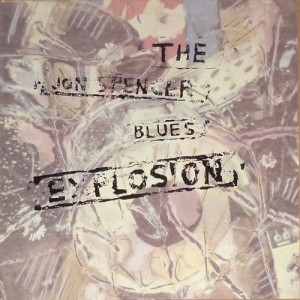
“The Jon Spencer Blues Explosion has released their first new album in three years.
While their previous album, “Acme,” was highly elaborate and experimental, “Plastic Fang” is sharp and aggressive, a return to their roots. It’s a masterpiece that truly embodies JSBX-style rock ‘n’ roll.
As a result, the guitar sound has the most presence of any of their previous works, and the groove created by Jon Spencer (vocals, guitar), who supports the bottom with growling distortion, and the algebraic and colorful Judah Bauer (guitar) is also amazing. We spoke to Jon, who made a surprise visit to Japan for promotion just before the album’s release, and Judah, who responded to a phone interview from his home in New York, about the attention to detail that went into the new album.
Jon Spencer. Great rock and roll record.
I think it’s the best album ever.
Not just making music,
I am also interested in music history and classics.
The new album has a strong rock n’ roll element, but what is the aim?
JON: I wanted it to be a great record…a classic album that everyone would love, an album that no one would find boring.
There are multiple engineers/mixers producing, but this time you’re the producer (only one).
JON: Up until now, we’ve never made an album with just one producer. So this time, we tried making an album with just one producer from start to finish. We’re not just interested in making music, we’re also interested in music history and classics, so we wanted to take our time and make an album with a musician as experienced as Steve.
When it comes to producing, Steve Jordan has worked with Keith Richards, so did you choose him because you liked his work?
JON: Actually, I had never listened to his music before we started working together. Steve is a mainstream musician, unlike us, so we hadn’t had any contact with him before. But when I met him, I realized he was a wonderful person both as a person and as a musician. He’s also an excellent producer, and Keith Richards’ albums in particular are organic, soulful, groovy, and amazing. I thought we could work well together.
Didn’t you think you’d be the one to produce it, as always?
JON: No, because we wanted to make an album in a new way this time. We’d already done it ourselves, and we wanted to take the next step. We wanted to grow. And to do that, we needed someone else’s help.
The sound itself is endless
JON: I spent a long time working with the best producers, carefully recording each song one by one. We still recorded everything in one take, but up until now I’ve just set up the equipment and recorded, but this time I carefully thought about what kind of sound I wanted for each song, and recorded while carefully selecting the guitars, amps, drums, and microphones…Well, I didn’t play every song on a different guitar, though.
But isn’t it rare to use multiple guitars?
JON: No, it wasn’t completely new. …………………I changed guitars, but mostly it was my main guitar. It’s the Japanese one I always use. It’s an incredible guitar that you can tell is different the moment you hear it, and it’s got a different sound. I used a lot of different amps; on one track I used four amps at once. I used an Epiphone amp on “Killer Wolf,” and on other tracks I used a Silvertone Case amp.
Amplifier?
JON: Yeah, it’s a guitar case with a 10W amp built in. You open the case and stand it up and it becomes an amp. It was made in the 50s or 60s and was sold at Sears (one of the biggest supermarket chains in the US). It was basically a cheap set that included a guitar, a case and an amp. I also used a Harmony guitar. The main amp was an old Vox cabinet with two 12-inch speakers, which was really heavy. I have a studio in the basement of my house, and bands who use it leave their equipment there. This was one of them. It was paired with a 100W custom head. It’s a solid-state head. That was the main setup for live, and it was the main setup for recording, but depending on the song I might add another amp, or maybe three. I used small Fender or Gibson Chip amps.
“The love of sound is the main guitar.
This guy is absolutely amazing.
SUNN Alpha was 212 yen. It was a great deal. I bought it recently.
JON: Yeah, the old one got stolen. The custom head is old, but I bought it a year ago. The solid-state amp matches my main guitar well. Judah uses a tube amp.
John’s main equipment used in the recording was the Osomitai Fujigen II guitar, a model produced by Fujigen as an overseas model around 1963. The tuning instruments were Dropro. The guitar on pages 24 & 20 is a spare of the same model, which he also mentioned in the interview, and appears to be in very good condition. He previously used a SUNN Alf 2128 amplifier, but it was apparently stolen, and now he uses a Custom 100 head and a Vox cabinet, both of which are from the 1960s.
Jon Spencer
It’s fun to use, and it’s really fun to make weird sounds out of it. (At this point the video finally arrives, and Jon begins to explain as he watches it.) Look, this is the studio. This is me, picking out amps, Judah’s in another room, playing guitar and running sounds through different amps, Steve’s playing bass, Judah’s amp is in another space. This is my guitar, the pretty one I mentioned earlier, this is the control room and this is the console.
I see, so it looks like you used a lot of amplifiers. Now back to your question…
JON (watches the video alone, seeming to really like it, then begins to explain again)…You can’t see the other amps very well, but all of my amps are in the same large space as Russell’s drums, and Judah’s equipment is in a separate space, and the door to the isolation room where Judah is is sometimes open and sometimes closed.
In the solo, he used an Ampeg Scrambler.
Did you use a whammy or something on “Like a Bat”?
JON: No, that was Roger Mayer’s Octavia, and he even used tremolo on “Hold On.” That’s about it.
“Having gained musical experience and life experience,
“That’s reflected in JSBX.
You used a lot more equipment than usual.
JON: Not so much effects pedals, but as far as amps go, I used a lot of different kinds of amps.
JON Okay
Overall, my guitar phrases have become more varied and I’ve gotten better (laughs).
JON: Isn’t it Judah who’s getting better? It makes me happy to see how Judah has grown.
It seems that Judah is studying Country and Blue Class.
JON He’s really studious and always practicing.
Besides JSBX, Judah is exploring blues and bluegrass with Twenty Miles (a duo with his brother Donovan [d]), and you’re exploring Hill Country with Spencer Dickinson (a duo with Luther and Cody Dickinson, sons of blues producer/musician Jim Dickinson, who released an album last year). Are you both also moving more and more towards roots music?
JON: I love Dickinson and his band’s music, and I was curious to see what would happen if I mixed it with my own roots in punk and New York no wave.
Is that reflected in JSBX’s music?
JON: Of course. However, just because we worked with the Dickinson Brothers doesn’t mean that JSBX will play Hill Country, so the influence isn’t immediately apparent when you listen to the music. But it’s definitely reflected, and it’s not just me, of course, but every member has musical and life experiences that are reflected in JSBX’s music. Anyway, I’ve always wanted to make an album that focuses on the band’s sound, performance, and songs. That doesn’t mean that we discussed it amongst ourselves, but this time it just came naturally.
We did it. The recording was fun and easy, and I think we’ve made a great album. I’m really proud of it…a great rock and roll record.
………Can I go back to the question?
I use a tube amp every once in a while, and sometimes I use a Mesa Boogie Mark II, III, or IV for live performances. Mesa Boogies are convenient to rent when I’m on tour; they’re ubiquitous, reliable, and sound great. But when I’m bringing my own gear, I go with solid-state.
The sound of the album is more like an overdriven vacuum tube than solid state…or rather, it sounds even bolder than that.
JON: Ultimately, the key to the sound is the main guitar. This guy is incredible. Of course, we didn’t just use solid-state amps on the recording, we also combined it with old Gibson amps, Fender Deluxes, and Fender Supers. When we were trying out different amp combinations, Steve said that this guitar really had a lot of character.
Did you use different amps for each song? That’s quite unusual.
JON: That’s right, I have a video showing the studio process. Can you bring it over? (He asks the staff.) I’ll explain when the video arrives, but in the studio, there was a microphone in front of me, and in front of that there were four or five amps. Then, using a splitter, I used two or four different amps at the same time.
At the same time?
JON: Yes, I blended a few different amps at the same time. Some songs only had one amp, others had four.
Some of them use distortion pedals, but most of the guitar is on the mains.
Oh, by the way, you still don’t know the name of the main guitarist (lol)?
JON: I don’t know. It just says “MADE IN JAPAN” on the back, but I don’t know the name.
After some research, I found out that it’s a Japanese-made guitar from around 1963, a Fujigen EJ-2 model, and the body is made of a wood called lauan, which is also used for furniture.
JON: Oh, Fuji Gen… thank you. I have two other guitars that are exactly the same as my main one, but they don’t produce the same sound. This main guitar has a dark sound, and the bass in particular is great.
Is the tuning drop D?
JON: Yeah, it’s drop D as always, except for “Mean Heart” with the acoustic guitar.
Outside. “Mean Heart” was me, Judah, Russell (Simmins/d) and Steve in a small room.
We sat together, we set up one or two microphones, I played acoustic guitar, Judah had a really tiny amp, Russell played drums, and Steve played big marching drums.
Was that your acoustic guitar and what did you use?
JON: It was a great guitar that Steve rented, but I don’t know where it was.
Did you use any effects?
JON: I overdubbed “Mean Heart.”
Judah Bauer
interview
It feels like I’ve been able to play my own guitar without any influence from anyone else.
“I just wanted to write a good song.
“That’s the most creative way.
JUDAH…Hi (seems very sleepy).
JUDAH No.
This is an interview with Jin.
JUDAH Ah, finally I can talk to someone I need to talk to.
Let’s start the interview right away.
JUDAH
Okay.
This is your first album in three years, what were you thinking about?
JUDAH: At first, we all got together and started writing songs.
I didn’t think about what kind of album I wanted, I just wanted to write good songs. That’s the most creative way. After writing a ton of songs, we discussed who to hire as a producer, and there were a lot of candidates, and after much deliberation, Steve Jordan’s name came up. I loved Keith Richards’ albums.
“So I asked him if he was going to do it, and he said he absolutely wanted it, because it was clear that if we worked with Steve it would be a traditional rock ‘n’ roll album.” At that point, the direction was pretty much set, and the recording was done in an old-school way, focusing on the guitar sound and drum tone and recording live. Up until now, I didn’t like the idea of a producer being involved in Pandora’s Box like a fourth member, but this time I really learned a lot from Steve, he helped me with the arrangements and I left the production entirely to him, I didn’t really care if a producer was there or not, I didn’t think he did much, but I come from a punk background so I’m quite suspicious of people.
–But it was different. I was lucky to work with him.
-It was.
I spoke to John the other day and it seems like he was very particular about the final shot. It was a fairly large studio, even though it was a video that showed Reg.
JUDAH: About 10 studios in New York
I looked around, checking out the rooms, equipment, and sound. Of all the studios, that one was the best, especially the drum sound. I knew it was a live recording, so I wanted to preserve the sound as it was, and the spacious space there allowed for good acoustics. What’s more, the console was a Helios. It was the one that was in London’s Olympic Studios in the ’60s, and just thinking about who had recorded on it in the past got me excited! All my favorite bands have recorded at Olympic Studios, from the Stones’ “Exile on Main Street” to Zeppelin’s “Levy Break” – all of the coolest sounds use the Helios. …………………Am I talking a bit too much?
No, no (laughs). It’s the exact same thing we used at the Helios Coolympia Studios, and we brought it to New York.
JUDAH: Yeah, it’s cool, right? You know that movie with the Stones, “Sympathy for the Devil”? That’s the console you see in there, it’s equipment from the late ’60s.
“While trying out various instruments.
“I kept trying until I found the sound that I thought was right.
Did you use old equipment for oil too!
JUDAH: Yes, I used it, and so did my guitar.
The same goes for the guitar Steve brought. We had about 20 amps lined up, all from the early ’60s. Fender Deluxes, Twee Ampegs, Vox…oh yeah, I used a Les Paul for the first time, a ’58 model. I’d avoided Les Pauls because they had a harsher sustain than a Telecaster, but I loved them so much that I later bought a ’76 model. I also used an Epiphone Cornet, which had a tone similar to Mick Taylor’s. We were all very particular about the sound. We kept trying out different instruments until we found the sound that we thought was right.
Is it?
JUDAH: Right. And a ’66 Telecaster.
what?.
JUDAH: For the recording, I used a ’51 Fender Twin and a Tweed Deluxe. Half of the album was made with those two. I also used a white Twin and a Paceman. So it was Keith Liss’s setup. Keith uses a Tweed Twin and a Tweed Bassman. I’m also particular about cables. My favorite is the George LS, which has the best tone and gain of any I’ve ever used. Mine is from Eric Johnson.
The guitar is a 1950 Esquire, a fairly rare instrument, but he uses it for live performances, so he replaced the tuning pegs and the pickups with ones from a 1966 model. However, he was worried about carrying it on tour, so he bought a 1967 Esquire instead. Judah has also changed his main amp, now using a Humax (tweed) and a Wine. The Deluxe is said to have the deepest distortion of all Fender amps.
It’s hard to do that (lol).
Are you still learning country/bluegrass licks?
JUDAH: I don’t know if it’s because of my studies, but I’m heavily influenced by it. I listen to a lot of ’60s honky tonk music. I love Winn Stewart from Bakersfield and Merle Haggard. Everyone uses a Telecaster, and for bluegrass stuff, I like Clarence White.
What country/bluegrass recordings would you recommend?
JUDAH: Well… I think a good place to start is Bob Dylan’s 1966 Royal Albert Hall live performance by Dylan & the Hawks. Robbie Robertson’s guitar sounds like Hubert Sumlin and is really cool, but it’s pretty complicated, so it might be difficult to copy (laughs). Clarence White’s online page has tablature, so you can practice with that too. Lately I’ve also been listening to dub and reggae. I find it interesting how the band creates a different sound and has a different rhythm than rock, and reggae is off-beat, right?
As Jon said, your playing is becoming more and more diverse.
JUDAH: Jon doesn’t practice at all, but I practice a lot, so it’s only natural that I’m getting better (laughs). But I’m still not good enough, I can’t play properly. It’s frustrating (laughs). Seriously, I always want to be able to play good solos, and when I hear Red Hot Chili Peppers on the radio, I think that guitarist there plays great guitar. I try to work hard every day too, but just because I practice doesn’t mean I’ll be able to play good guitar, so practicing alone is hard.
Roach is different, he values the sound of the whole band, so he’s not like a rock band with a frontman.
The stance is different from the band, the pinnacle of that field is Ernest Ranglin, his playing reminds me of Jimmy Nolan, I also like Roy Buchanan, he was an oddball, but he was good at fingerpicking.
King is amazing. And he even uses a Telecaster (lol). Oops, I’ve talked too much again.
That’s not true (lol). By the way, it seems that Twenty Miles’ new album will be completed soon.
JUDAH: That’s right, I wanted the new album to have a Stones bootleg feel (laughs). It’s a lo-fi album recorded at home.
It’s an organic sound.
Jon also released an album with Spencer Dickinson that explored the Hill Country. What are your thoughts on that album?
JUDAH: I haven’t heard it yet. He won’t tell me anything (sigh). I tell him all about what I’ve been up to lately, but Jon won’t tell me anything. Someone told me he was doing Hill Country… but Jon…
I wonder if they understand Hill Country (laughs). Really? (laughs). Has your perspective on guitar changed as you pursued your roots?
JUDAH: Of course, as I’ve been playing guitar for years, my heart has grown and my ears have gotten better. Also, up until now, the influence of the music and guitarists I listened to has been reflected in my guitar playing, but this time, I feel like I’ve been able to play my own guitar without anyone else’s influence. It’s the first time. I feel like I’ve finally created something I’ve been wanting for 10 years, something good musically. A blues-based guitar sound.
It’s a super rock album, it makes me happy.
It’s a model, but you can only buy it in Japan, I guess because Japanese people are so particular about the small details. Whenever I go to Japan, I always buy a bunch, Japan is the best place to buy shields.
Wow, I didn’t know that.
JUDAH “The Midnight Creep”
I used Emma and Ampeg amps. The tremolos on these two have a rich, dark, and amazing sound. I used the two with an A/B box. Also, it’s not my field so I don’t know the details, but I used a variety of microphones, like AKG and Neumann, and changed the position. For each song, I always used two different amps. I tried 7-8 amps for each song and thought about the best combination. Once I decided on the amp, I also decided on the type and position of the microphone.
Have you bought any new guitars recently?
JUDAH: The ’76 Les Paul I mentioned earlier.
I have a Black Beauty and a ’66 white Telecaster, which I thought sounded like Robbie Robertson (laughs), and a ’67 Esquire. The ’51 one is really rare, so I don’t want to take it on tour. I still buy and sell guitars frequently, but I’ve realized recently that having a good guitar doesn’t necessarily make you a better guitarist, so I’ve been holding back on buying guitars, but I think it’s better to practice than to buy (laughs).
By the way, I heard you said you wanted to sell guitars in Japan.
I said, did it sell?
JUDAH: I thought I could sell it for a higher price in Japan, but I ended up selling it in America. I sold my Gretsch and L-5 at the time, because I’m a clumsy guy and I can’t play the L-5 well (laughs). What I want now is a good splitter box, one that doesn’t compromise the quality of the sound. I’ve tried about five different ones, but I couldn’t find one I liked, so I’m thinking of asking Beat Cornish.
I still can’t play it properly.
It’s frustrating (laughs).
As for your guitar playing, your phrases seem to be at the core of many of the songs this time. “Like a Bat” has the candid feel you’re pursuing,
JUDAH “Like a Bat” is the song I wrote when I was a kid.
I was playing Rays and then the other guys joined in and it just came naturally. I still listen to a lot of country and bluegrass, and thanks to Clarence White I started using a B-bender. I play the final solo on “Killer Wolf,” and I fingerpick on “Like a Bat” and “Money Rock ‘n’ Roll.” I’m finally getting good at playing country style (laughs). I used an Epiphone Cornet for the slide on “Down in the Beast,” and the P-90 gave it a great vibe. The sustain was amazing, and I thought, “This sounds like a great performance!” All thanks to the pickups (laughs).”