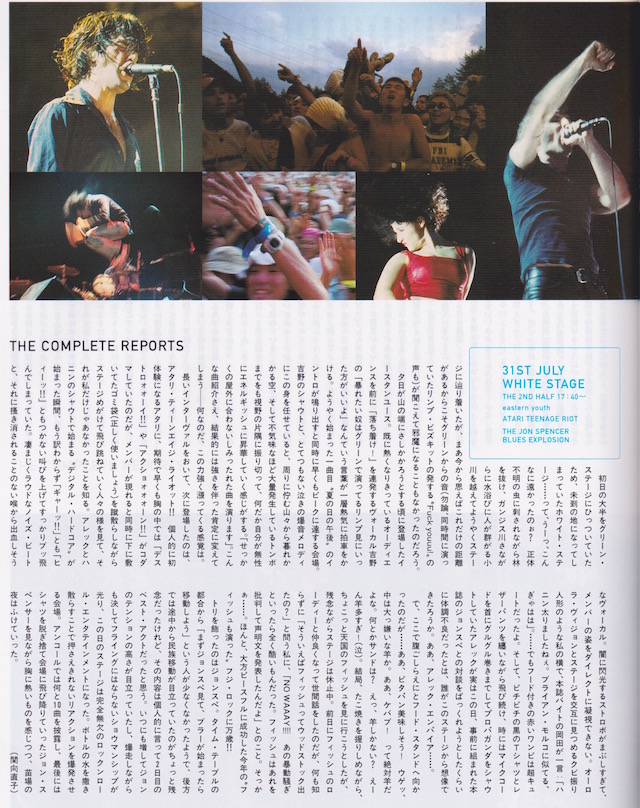
“Anyway, that was the whole 30 minutes that Jon and Alec spent together. After that, they spent a little time together in the room, and then they had a big fire on the White Stage. Alec’s raised fist and his naked body were both there.
Text by Jun Shikano (translator) and Noriyuki Takami (photo by Hirohiko Taniguchi)
I was impressed with Jon’s dedication. After I told him the situation, he muttered “No problem” and waited alone for 10 minutes, and then, just when I thought he’d lost patience, he called his wife Cristina and told her about a business meeting with Boss Hog.
I am truly grateful.
Just seeing these two faces side by side makes you think “We did it!” and the interview between Jon Spencer and Alec Empire has finally come to fruition. It took 10 months of planning, but once the offer was made, both of them said yes the very next day! It was a quick success. However, the day of the interview turned out to be quite a difficult one. This is because Alec Empire fell ill, which put the interview in jeopardy. Incidentally, the interview took place at 1pm on July 11th. Isn’t that the day of the live show?
However, I guess Alec Banchou thought he couldn’t betray Jon Spencer after all. Even though his other interviews were with DESTROY!, he rushed over to this interview.
J: “Really? Anyway, it all started with Russell. We toured America together a few times, and I think that was… about three years ago?”
“Yes, 35 years.”
I see. What did you think when you received the offer from JSBX, Alec?
A: I accepted without hesitation. Blues Explosion has been around for a long time.
It was Ann, and then around the third year, we were getting tired of techno. Hanin and I started listening to stuff like Oblivion and Clivet label bands, and of course we listened to Bushy Galore too. We were just at the point where we wanted to play JSBX-style rock, so it was a godsend.
Briefs spilling out from the bottom of his jacket
I strongly hope that you will immerse yourself in this conversation, remembering the dazzling atmosphere of that time.
This is a long-awaited conversation that has finally come true for us, so let’s start by talking about how we first met.
Jon (J) “Russell (Simins)
“Now I Got Worry”
I was recording at Na when Bertie came over and Russell brought his Atari and Digital Hardcore tapes. That was the first time I heard them. About a year later, I asked him if he’d like to support The Blues Explosion on their US tour. I think that was the first time we met. You hadn’t met before that, right?” Alec (hereafter A): “No, didn’t you meet in Berlin? When The Blues Explosion played with Burnside?”
A: “In my case, I want to fully support the energy and vitality of JSBX’s live shows. There aren’t many bands like that these days, are there? This was particularly evident last year, but electronic music has gradually stripped away all the unnecessary elements, and there’s been too much perfectionism, and in any case, it just doesn’t feel energetic at all. In that sense, JSBX is full of energy and powerful…I feel a power that can’t be compared to any other drum and bass DJ. I respect that about them. And also the beat. It’s a bank-style funky, hard, super-fast beat.
That’s similar to us… I wonder what Jon thinks.
I’m tired of frivolous raves now (laughs).”
I see. What I feel is that compared to other musicians, you two have very clear likes and dislikes, but the fact that you’ve toured so much and collaborated so many times suggests that you have some kind of sympathy or respect for each other. Could you tell me more about that?
J: (wry smile) Well, I’m a big fan of Atari’s music, and I respect Alec, including his personality. But, well, I’m certainly the kind of person you just described, but I guess it’s a kind of Bank Rock kind of lifestyle. I mean, I’m that kind of person at heart, you know.
I don’t know if that’s true (laughs).”
J: (Nodding) No, no, I think that’s what it is. But, when I played Atari, he was so powerful, I tried to ignore him.
Even though we were making a sound that couldn’t be ignored, the Blues Explosion audience, how should I put it, were a little put off. I thought it was strange, since we weren’t a bad band. But then, when we toured again with just the Blues Explosion, wherever we went, people praised us, saying things like, “That opening band last time was amazing. Was it Atari Teenage?” and “That was the first time I’d ever heard anything like that.” I was a little worried, wondering, “Are we the only ones who think Atari is good?” (laughs)
A: “Hehehehehe.”
J: In the end, it had a huge impact.
(laughs) We are both very cool and collected people, but I think we are similar in that we both deliver straightforward music and performances.
J: “Well… that may be true.”
A: (laughs) I don’t know. Of course I live a life filled with anger all day long, but I don’t want to take out my anger on everyone in the world.
J: You’re saying that anger can be released through music, right?
“That’s right. If you were angry all year round in real life, you wouldn’t be able to make the kind of music you do now, right? When I say Atari, I mean, people who meet us in person and criticize our music.
Some people get scared that they’ll get beaten up, but that’s a big misunderstanding (laughs). I don’t know why we’re so easily misunderstood. I don’t judge other people’s character by their music. I don’t know why people think like that. (laughs)
Well then. I think the reality of making music differs depending on where you live. Jon was making German industrial sounds during his time with Pussy Galore, and I think Alec definitely got feedback from New York. I think it’s interesting how their music has intermingled in this way, so could you give us a brief comment on that?
J: “Well, I think that’s what Pussy Galore was like, but…”
I can’t comment on what happened.”
A: “Well, I guess I was influenced by the New York hardcore guitar scene. I’m not sure.”
Did you play it yourself?”
J: By the way, I was surprised that your new album has a very rock sound. Did you use samples for that?
A: We did it ourselves. We used a lot of samplers on the previous two albums, but this time we didn’t use any. I played all the guitars myself. I had a guest guitarist play on one song.
But this time, even the recording process was completely different from before. First, we played all the sounds ourselves and recorded them on tape, and used those as sampling sources. On our previous albums, about half of the material was played on guitar, and the rest was made using a sound collage-like technique.”
J: “Um, where did you get the guitar samples from the previous method?”
A: “Well, our concept in the beginning was that when we sampled a sound from a record, the aim was to steal the energy and spirit of that record. It wasn’t about conveying whose records we’d listened to or the source of the sample. At that time, 5% was sampling. Even the snare drum was sampled. The aim wasn’t which band the sound was from, but to incorporate the revolutionary spirit that the sound had, like this world is waiting, this sound is going to turn the world upside down.”
J: “I see.”
A: “We thought that by combining such highly spiritual elements, we could further increase the energy. It was a process of reviving the energy condensed in a certain moment and replacing it with our own contemporary context.”
J: So, does this album feel like a step away from that idea?
A: Yes. I wanted to confront the music itself more. That’s why we did everything ourselves. However, we left the mixer to someone else. In other words, when I mixed down the sound,
I won’t be satisfied unless I raise the needle all the way to the red zone (laughs). And then my blog gets mad at me for being so unreasonable (laughs). Anyway, I just want to see how other people do it.”
J: “I see (wry smile).”
Well, the reason I asked that question earlier is because I’ve previously heard from you both about your musical development in your adolescence. Jon, despite being American, said that he was deeply influenced by Kraftwerk. And Alec, despite being German, said that he was influenced by Grandmaster Flash and moved on to hip-hop, which is where he is today. I thought this kind of exchange was really interesting.
J: Yeah, well, it’s certainly interesting (laughs)
A: “Also, Grandmaster Flash was influenced by Kraftwerk. That’s interesting. But to be honest, I didn’t really like Kraftwerk.”
Huh, why?
A: “Anything (laughs). It’s a funny story, but the first records I ever owned were given to me as a Christmas present when I was 9 years old. One of them was by Kraftwerk. I think it was “Computer World.” And the other one was by Trio. Do you know them?”
J: (Laughs) Did you like the trio?
A: Yeah. At the time I thought the trio was somehow better (Laughs). Kraftwerk didn’t really appeal to me. Usually, if a techno person gets their hands on their first record, they think it’s really cool, but in my case it’s the complete opposite.
J: (laughs) That’s right.
After all, it’s music for the socially marginalized, right? So this kind of sci-fi music…”
J: No, in my opinion, hip hop fans are just fed up with the beats. It’s just that white people think hip hop is cool now and are listening to it—
A: “No, but… how can I put it, the positioning is different. There’s a sense of escape from everyday life, right? In Germany, there are businessmen in suits walking around everywhere. So for me, music like Grandmaster Flash is more of an escape from the environment around me. I think it’s probably the other way around in America. Kraftwerk is perceived in that way too, isn’t it? I think Detroit’s Derrick May was basically expressing a feeling of alienation from society.”
J: “I see. I’ll just go to the bathroom.”
Hey! Don’t run away, Jon (laughs). To Germans, Kraf (Taka), to Germans, Krafwerk is futuristic music.
Or is it nothing like that at all and something that happens every day?
A: “They’ve basically been respected, haven’t they? But at some point, they became a band that was the pride of the German nation. So, for example, there was an exhibition in Cologne the other day, and Kraftwerk provided the music, and the government invested 1.4 million marks or something. That means–”
A: “No, I think Kraftwerk’s achievements are incredible now, and they’re an important band, but they still have a different approach from us. That kind of technology-centric, impersonal stuff doesn’t resonate with our philosophy. Of course, I understand that they did it ironically, but the so-called techno generation uncritically accepted that image and became a sacrifice for technology, right? I can’t agree with that kind of people.”
J: “I see… That said, I’ve never been a fan of techno. When I was growing up, rock meant Lynyrd Skynyrd and the Grateful Dead, right? On the other hand, Kraftwerk was far removed from what was considered “rock” at the time, which is why I liked them. I could relate more to futuristic, future-oriented music.”
A: Also, I think Kraftwerk’s position is a little different in Germany. Hip hop,
A: “Hehehe. I was once offered money to use it in an advertisement (laughs).”
J: (Coming back) By the way, does Atari’s music ever get used in commercials? (lol)
J: “But you don’t want it to be used in commercials? What about movies?”
A: “Movies are different, aren’t they? Aren’t they made by a different race? But whatever. It’s not like the people making them are a different race, there are a lot of nasty people with industry streak either. They put their music in things like “Spawn” and other terrible things. But I still don’t like the idea of our music being used in advertisements to promote a specific company’s products. One time a beer company contacted me (laughs). They said they wanted to edit “Deutschland Has Gotta Die” and use it. They wanted to use the “Deutschland” part. After “Deutschland”, they cut out “Die” and immediately brought in the beat (laughs). That would be completely pointless (laughs). For example, I think it would be fine if an Atari song was playing from a car stereo in a scene in a movie. That way Atari’s songs and message could be conveyed more widely. That happened on our recent US tour, too. That happened on our tour too. There were a lot of teenagers who said they got into Atari-style music because of movie soundtracks. I think it’s great if it has that kind of effect. But I don’t think there are people who would find out about Atari through a beer ad and become a fan (laughs). Have you ever done a commercial for John Sube?
J: “Several times. But they edited it without permission and it became a blues explosion.
“The songs sounded so different from ours. For example, we used a B-side. It was a bunch of noise recorded on a Walkman while on tour, so no one would know it was ours. It was a secret track, with no title, more like a sound collage than a song.”
Now, let’s change the topic a bit. You two are positioned as big brothers and teachers to the male readers of BUZZ, giving them the courage to live. I’ll give you some keywords, and I’d like you to send a spiritual message to young people.
J&A「(Hilarious)」
First, let’s talk about the possibilities and limitations of love and sex that modern music can express.
“Huff (sigh)”
A: “That’s a great theme (laughs). But you could also say that there are no other themes in music (laughs).”
A: “If you make noise, isn’t that love and sex? When you have sex, noise comes out, right? Is it normal? Or rather, sometimes? (laughs)… (getting serious)
J: (wry smile) It would be bad if I revealed the secret, so I’ll keep it a secret.
Is it funk?”
For example, Alec has his own sound.
How do you intend to incorporate love and sex into your music?
A: “In the case of Atari, I think it’s exactly as it appears.
But there are two guys and two girls, and when the four of us play music together, a certain energy is generated.
I think this structure is very important. In other words, the music is hard, but not male-centric. It’s energy and power that incorporates feminist thinking and female energy. If I were to define sexy music, it would be music that can be listened to by both men and women. For example, only men listen to heavy metal, right? That’s not sexy (laughs). That’s what I think, but what do you think, John?
J: (bitter smile) I agree that heavy metal isn’t sexy (laughs). But I haven’t seen many Atari live shows.
A: Overall, there are a lot of girls in the audience.
It’s really exciting. It seems like what we do, and especially Hanin’s presence, gives girls courage. After a show, Hanin is often surrounded by girls saying things like, “I feel so brave, thank you.” It’s a shame that the only role models girls have are the Spice Girls. There should be something more decent.”
Okay, so next, I think you both have been to Japan often and have seen the society there, so please tell us what you see as the positive and negative aspects of Japan’s future.
“Hmm. The good thing about Japan is that the food is delicious. The bad thing is that everyone is overly polite. They say things in a roundabout way when a simple “no” would suffice, so sometimes communication doesn’t go well. Sometimes it’s no good. Sometimes it’s no good.
“It seems like they have a resistance to saying ‘me’.” A “In a way, that may be true. I don’t know if it’s a flaw or not, but I don’t understand why people have to buy so many things. Well, I don’t want to judge by just looking at it, but it seems like there are some people for whom consumption is their purpose in life. I don’t know how much they can buy before they’re satisfied. Also, there’s excessive packaging. Whenever you buy something, it’s wrapped at least three times. It’s wasteful. But even so,
This may be true in Germany to a lesser extent, but it is true in any capitalist country.
That’s part of it. It might be a problem of consumer society. The good thing about them is, and this is only limited to the Japanese people I’ve met, but they have the attitude of trying to understand something before passing judgment on whether it’s good or bad, which I think is a good thing. Germans don’t do this. When they find something new, they immediately decide whether it’s good or bad, and that’s it. When they find this, they immediately decide whether it’s good or bad, and that’s it. They don’t even try to understand it from a neutral perspective. At least all the Japanese people I’ve met, when they come across something new, they seem to first gather information about it and try to understand it better, without prejudice.
I see. Japanese kids express a direct appreciation for the music you make, and I think they have a really good way of interacting with it. What do you think as a person involved?
J: “Yeah, that’s true. You can really feel the passion.” A: “It’s passionate, isn’t it? I felt that they respected us from the first time we came to Japan. As for the language barrier, there are some bands that are cynical and say, ‘The problem with Japan is that they’re just attracted to our hard music without understanding the true nature of what we do,’ but I think that’s a big mistake. They really understand the underlying context of our music. For example, just yesterday, a Japanese fan said to me, ‘I’m looking for Japan.’ For example, a Japanese fan said to me, ‘I’m looking for Japan.’ Right now, the wiretapping bill is about to pass the Diet, right? In this shady situation, an event with Atari and Blues Explosion is very significant, so they asked me to do my best to get their message across. In the sense of presenting a different set of values.”
Now, this is the last question. You two have suddenly been asked to revitalize the music of an artist you are co-producing. Please discuss which artist you would like to produce and how.
A: “Hahahaha, that’s a tough decision. What should we do?”
J: The first band that comes to mind is Public Enemy.
“I have to save him.”
A: “Hehehehe”
J: “Also, Prince.”
Are you confident in producing Prince?
A: “Buwahahahahaha”
J: “Yes”
A: “I think I could do it too. I don’t know about production, but I could do a remix. Generally, anyone can do a remix if asked. I was once almost asked to do a remix for Michael Jackson. It might be good to throw some Kan-like noise at Prince.
♪You want me to scream “Destroy!”?
It’s not worth it (laughs)”
A: No (laughs), the lyrics are fine as they are. Just the distortion.
A: “Well, let’s do it sometime.”
J: “Hmm, that’s not bad (lol)””
“The first time I met Jon was at a Jesus and Mary Chain show, and we both thought we’d hooked the other up!
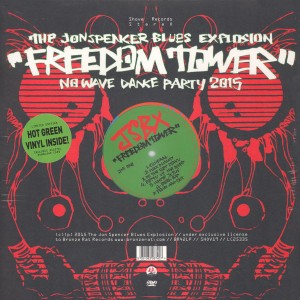
The album “Whiteout” was created to index post-alternative music.
Why does Boss Hog have a different perspective than Pussy Galore or Blues Explosion? Here is the definitive “Jon and Christina’s Story”!
Text by Jun Shikano
Drum machine, tremolo-driven organ, Cristina’s seductive vocals croaking “chu chu chu,” and Jon’s guitar playing digital cuts. The title is “Stereolite,” and, of course, it’s produced by Tore Johansen. As this top tune suggests, Boss Hog’s album “Whiteout” resonates with a chaotic rock ‘n’ roll funk, combining a radical post-alternative perspective with a New York sound style that contrasts with the sleepy “cool” of the Velvet Underground. What’s more, the cover features the poster on the back. The image of Jon and Cristina glaring in unison, “I don’t want people to think I’ve become weak just because I’ve had a kid,” forces open our closed eyes.
Even so, we still know very little about Boss Hog. As a sub-band for Blues Explosion connoisseurs, they’re fine as they are, but with such a wide-open, happy-junk sound, that’s no longer the case. And, as you’d expect from Tore Johansen and Andy Gill of Gang of Four, who produced them, it’s meticulously crafted. It’s a different beast from the nihilistic ideas of 80’s New Wave, a solid feel for the new millennium. In short, it’s straightforward. So we can’t just ignore it. So, we asked Christina to tell us the overall story of Boss Hog…and the focus, as expected, becomes “John and Christina’s story.” OK!!
You were born and raised in Washington, DC. What was your childhood and adolescence like before you met Bank?
“I was a very controlling child (laughs). I guess people who knew me back then would see me as a very quiet person now. I wasn’t satisfied unless I got everything my way. I’m still like that now.
Since I was a child, I have always thought of the world as my own.
I tried so hard to manipulate him to get what I wanted.
But it’s impossible, and in the end, it’s just a waste of effort. We can’t control anything. I know that, but I still try to do it anyway, which is my weakness, and I’m trying to fix that somehow (laughs). Basically, I didn’t have a very happy childhood. Nothing went the way I wanted, and I wasn’t blessed with anything materially. My parents were working-class and not wealthy at all, but they worked hard to get me into a top private school. So I ended up surrounded by kids who were much wealthier than me. That was also part of my unhappiness. I was forced to be aware of my social and economic status. I studied hard and tried to be like everyone else, but I never felt like I fit in. I was always the quietest kid in class, and I was often teased because my parents were immigrants and couldn’t speak English properly. Children are cruel, so they will relentlessly attack things that they cannot do anything about. It was a very tough environment.”
Do you think that being in that environment at that school made you a rebel?
“Yes. It made me the perfect rebel. I was a villain, I didn’t conform to anyone. And I think it was that frustration that grew from that environment that drove me to express myself. I needed a way to vent my anger, and when I got on stage and let out all my frustrations, I got a lot of satisfaction. And so, actually, I met Jon at a Jesus and Mary Chain show.”
Wow, that certainly sounds like it.
“Right? The strange thing is, in both cases, you’re the one who’s the other person.
(Laughs) I thought I’d hooked him up. Basically, we were attracted to each other. I was 18. It was ’85. And he’s been my only friend ever since. (Laughs) It’s a tragic story. (Laughs)
He then joined Pussy Galore.
“Yes. Pussy Galore was originally his band. After we met in DC, I wanted to do a movie, and Jon wanted to relocate the band, so we both moved to New York. At the time, Neil Hagerty (now with Royal Trux) was in the band and didn’t want to leave DC, so Jon asked me if I’d play guitar in his place. So I joined the band and played for about a year and a half. Then Neil came to New York, and we ended up with overlapping band members, and we started taking turns playing because we felt bad for each other (laughs). So, eventually, either I or Neil had to leave the band, and Jon wanted to continue his romantic relationship with me, so it was me who left. It wasn’t my decision, that choice (laughs).”
So when you joined Pussy Galore, you were already romantically involved with Jon?
“Yeah”
Was it love at first sight with Jon? “Well, it would be better to say it was a love-hate relationship (laughs). Anyway, my relationship with him was always up and down, right from the very beginning. When I first saw him, I thought he was a bit of a jerk. But later that night, when I heard him talk, I changed my mind and thought maybe he wasn’t as bad as I thought (laughs). …But I did think he was a handsome guy (laughs).”
What did you want to do and what dreams did you have back then?
“Well… my dream has always been to be happy.
And to be loved…that’s all I wanted, basically. At that time, I was just happy to be in a band. I think all I was thinking about was wanting to be with Jon, express myself, and be understood. Of course, as the band’s leader, Jon wanted the band to continue and be successful, but I wasn’t thinking about those things at all.”
So you formed Boss Hog in 1989 and broke the dam of your sensibility. But then you suddenly appeared completely nude on the covers of “Drinkin’, Wrechin’ & Lyin’” and “Cold Hands.” Why did you do that in the first place?
“Because I wanted to do it (laughs). But isn’t that basically how humans are? Don’t you want to be the life of the party? You want to be, right? (laughs) Everyone does. Everyone wants to be the hero of their university! (laughs)”
Okay. I understand. When you started with Boss Hog, the grunge movement was just starting to take hold. How did you react to that movement?
“Yeah! I hated grunge music. At the time, a friend of mine, Jody Krull, who later joined Geffen Records, was in charge of organizing shows at a place called the Pyramid Club in the East Village. She once asked me if I wanted to play with Nirvana. She wanted Nirvana to open for us, but I said absolutely no! I was like, ‘I hate that band, I never want to share the stage with them again!’ (laughs)”
I think the basic idea behind Boss Hog’s activities is to rebel against the so-called normal world, while at the same time trying to create new, energetic communication… “Oh, that’s a cool phrase. I like it.
Yes (lol). …(a huge banging noise in the background) Sorry, it looks like there are more kids coming. Please wait a moment. …and China waited for a while… “Hey, can you be a little quieter and stop hitting me?
Can I call you now? I bought you a set and you seem to like it.
He keeps hitting the drums all the time, and even if I hide the sticks, he says, “Give me your drumsticks!” and starts hitting the drums again right away. It’s so cute (laughs). Sorry for being so noisy.”
No, no. You seem to have a lot of musical talent, so I’m excited to see what the future holds (laughs). So, has your rebellious spirit changed with the arrival of your new child?
“Yes, I think having children has made my attitude towards life a lot more mellow. In particular, I feel less anger. I feel like having children is slowly repairing the wounds I received as a child. All the emotions that had been suppressed come flooding out, and once it’s all out, I feel so healed. I’m really glad that I had children.”
You and Jon are often likened to Bonny and Clyde. What pride do you take in the way you live and express your life that comes from your relationship?
………………That’s a pretty tough question (laughs). Well, what can I say… Anyway, my life with Jon up until now has been like riding a really big roller coaster. At least that’s how I feel. There were really high mountains and really deep valleys, it was a roller coaster of screams, it was really fun (laughs). There were good and bad things mixed together, but I’m glad I met him. I wouldn’t be who I am today if I hadn’t met him. I wouldn’t have been able to do the kind of work I’ve done up until now.
I feel incredibly proud and confident in what I have achieved with him as an artist, because I would not have been able to do so if I hadn’t.”
I’m trying to do an interview with Alec Empire and Jon on a rock site that will last 3-4 days, but his “nice guy” behavior lately is enough to confuse any rock n’ roll junkie, isn’t it? As someone who’s probably still constantly nitpicking Joh, what do you think about this?
“Jon is definitely trying very hard to change (hehe) mentally and intellectually. He’s really trying to improve himself. I think he’s changed a lot, actually. He still has a long way to go.”
Do you still have a long way to go? (laughs) As a husband? Or as an artist? “As a human being.”
But when I saw John’s saggy hair when he showed me the photo of Paevey, I seriously thought about saying, “Why don’t you retire and follow in John Lennon’s footsteps and raise your children?”
“Really? I don’t really know what kind of person he is in front of other people… but he really does love that child with all his heart, I think you could even say love. He’s a really good father, and I think it’s an undeniable fact that he’s grown so much since becoming a father.”
So basically, you welcome this change in him?
“Of course, I think having children is a very healing thing for most people, and it made John try really hard to improve himself, and I think that’s very cool of him, you know?”