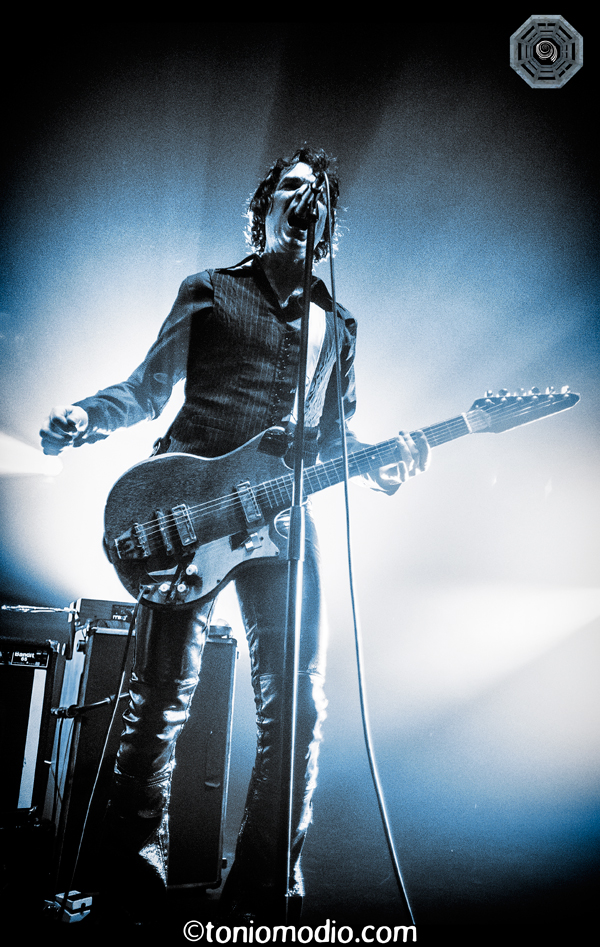
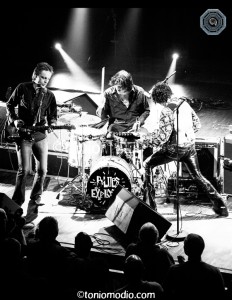
“JON & JUDAH
I don’t have much technique, but I think I can express my individuality through playing the guitar. There’s nothing I can’t do.
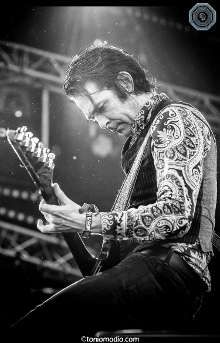
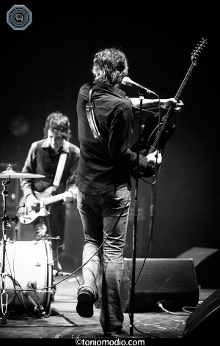
With their masterpiece “Now I Got Worry,” released last year, the Jon Spencer Blues Explosion has once again taken Japan by storm. This trio’s intense, real rock ‘n’ roll is born. Despite their bass-less lineup of two guitars and drums, they produce an extremely thick and innovative sound. Their music transcends the boundaries of punk, garage, blues, hip-hop, and more, absorbing them all! Above all, we mustn’t forget that their cutting-edge rock is colored solely by the electric guitar, a primitive instrument that gives way to primal impulses. Jon Spencer, the darling of the rock world, and Judah Bower, who coolly supports them, are the two guitarists whose authentic voices are presented here.
Following your visit to Japan in 1995, Jon came to Japan again last year for a Boss Hog concert. Has your image of Japan changed?
JON: Yes, I first came to Japan with Pussy Galore in ’87 or ’88, and then I came again in ’95, and I’ve always had a great time. I love coming to Japan.
The show this time was mainly comprised of songs from your new album, “Now I Got Worry.” Is the set the same as the other international tours?
JON: It’s pretty much the same, but I try to change the set up every night. I keep it open.
You don’t create set lists for your shows, do you decide what songs you’ll play each night before you go on stage?
JON: No. I’ll say, “Let’s do this” on the spot, or I’ll just start playing. If it’s a song that starts with my guitar or vocals, I can just start playing, but if it’s a song that requires everyone to start together, or if another member starts, I’ll say, “Which song should we play next?” on the spot.
So all the band members are prepared to play any song at any time?
JON: That’s right.
JUDAH: Anytime is OK.
What song is the most fun to play live?
JON: From the new album, I’d love to play “Skunk.” Well, some of the other new albums are fun to play too.
JUDAH: I’ve been touring for a while now, so I prefer to play new songs. I’m tired of the old songs. Now I have new songs, so that’s good. But it depends on the day which songs I enjoy the most.
Do you think about what songs the audience wants to hear?
JON: We try to play those kinds of songs because we want to make the audience happy. We keep that in mind every night.
Is playing guitar live very different from playing guitar in the studio?
JON: Yes, it’s a little different. But some of the songs we play when we record have been performed live for months or even a year, and are perfected as we perform them on stage. Those songs are very familiar. In fact, most of the songs are developed in that way, but on every album there are a few songs that were written just a few days before going into the studio. Those songs are brand new when we record them, but they change as we play them live. Also, in the studio we have access to a variety of guitar amps, which gives us more freedom to express ourselves. The songs on the album are played by the whole band at once. We all gathered in the same room and recorded together. All the basic tracks were recorded live. The situation is not that different between live performances and albums.
Do you mean no?
JON: No, that’s completely different. The big difference is there’s no audience.
JUDAH: In the studio, we do mixing too. We adjust the EQ. We also record the sound onto tape.
There is a task of fitting it into this.
What is more important: live performances or albums?
JON It’s live.
But in the studio you can try things that you can’t do live, right?
JON: Yes, you can correct mistakes, or you can highlight mistakes. It’s different in that you can do a lot of different things. But what we try to do live is totally different from what we do in the studio. Listening to a record and seeing a concert are totally different experiences.
The new album sounds very solid and stripped away. I think this is also connected to the fact that new songs like “Wail” and “Rocket Ship” look great on stage. Are you planning to recreate the sound of the album in your live shows?
JON: I don’t really mind that. Our live setup is always just two guitars and drums, so we can only do what we can within that. Naturally, some songs end up feeling different from the album. For example, in the studio we overdubbed an acoustic slide guitar on “Rocket Ship,” which obviously can’t be replicated live. There’s a limit to what we can do live. Sometimes we rearrange songs for the live show, and sometimes we develop parts.
So when you write songs, do you write them as songs to be performed in the studio, without any particular stage performance in mind?
JON: That’s right. When I’m making an album, I don’t think about live performances. I think about what kind of album I want to hear.
While this album has an earthy feel, there are also parts that have an editing feel that is inherent in rap music. Was that something you were conscious of?
JON: Yes, I took a more casual approach with this album. I didn’t put as much thought into the recording process as I did with “Orange.” I just had fun playing and went with the flow. But once recording was finished and it was time to mix and decide the track order, I started to think a lot. I also did a lot of editing.
Did you do a lot of overdubbing? JON: Yes. As I said earlier, we dubbed an acoustic guitar on “Rocket Ship,” and we did a lot of other overdubs as well. But we didn’t do any overdubs to fix the guitar or drum parts. First, we all played together and recorded the basic track several times, and then we chose the best one from those. Even if there were mistakes, we didn’t fix them, but rather thought about how to make the most of them. Were there any points you paid particular attention to when recording your voice or the recording process?
JON: I usually record the vocals live along with the basic tracks, because that gives the whole album a better feel. I often don’t use the vocals and re-record them separately later. Do you feel that you’re very particular about the sound quality of the guitars? Were you conscious of that?
JUDAH: I don’t know if it’s a particular thing, but I don’t really like using distortion. I like a clear sound like Steve Cropper.
This album was recorded in various places.
I heard that you have been downloaded?
JON: Yes. We did a couple of days at Easley Studios in Memphis, Tennessee, a few days at Geeson Studios in LA with engineer Mario Caldate, and a few days at Waterworks West Studios in Tucson, Arizona with Jim Waters. Most of the mixing was done in Tucson.
Why did you perform in so many different locations?
JON: Well, we were in the studio when we could. Also, we wanted to work with Jim Waters. He recorded and mixed “Orange” and “Extra Width,” and we’re friends. He’s a really easy guy to work with. Jim Waters has a studio in Tucson, Arizona. He’s got a great sense of humor and he understands the band, so we wanted to work with him again.
There are a variety of guests on this album. First of all, Ad-Rock from the Beastie Boys is on it…
JON: We recorded the song “Cool Vee” in Memphis, and after we finished, we went to G-son Studios in LA. G-son is the Beastie Boys’ studio, so we thought it would be good to have Ad-Rock do some scratches.
In addition, the great Rufus Thomas is also participating in the new work.
JON: A song called “Chicken Dog” in Memphis
It was when we were recording “Chicken Dog.” It’s an old song for us, and we’d been playing it live as an instrumental for years. We called it “Chicken Dog” because we thought it had a Stax soul instrumental feel, and it was a play on the Stax tradition of “chicken songs” and “dog songs.” We were joking about how it would be great if we could get Rufus Thomas, who was famous for his funky chicken walks and dog walks, to come on. Someone at the studio in Memphis heard that.
He said he thought I should call him because he would be there. So I called Rufus Thomas, and he showed up a couple of hours later and did the vocals, the barks and the growls on “Chicken Dog.”
In your music, new rock artists like the Beastie Boys and Beck, and R&B and music legends like Rufus and R.L. Burnside, are all on the same level. Do you feel the same about each of them?
JON: No.
JUDAH: Not at all. The blues and R&B guys are way deeper. And that’s the kind of music I listen to more.
Please tell us about your collaborative album with R.L. Burnside, “ASS POCKET OF WHISKEY.” How did that album come about?
JON: First of all, we were fans of R.L. Burnside. He made some great records. So we thought it would be great to do some shows together in America, and we organized a tour with him, and it went surprisingly well. The show was great, and we had a lot of fun.
“The Blues Explosion” was a huge hit with R.L. Burnside and his band, and we had a great time too. Getting to know Burnside and his band was great, but even better, we got to see him play every night! That was the best thing for us. It was such a success that we toured the US a few more times, and we became friends along the way. We even shared the stage during encores. So we decided to make an album together.
What kind of album did you want to make?
JON: We didn’t have any particular plans. We just wanted to go to the recording studio and play together.
JUDAH: I never even thought about making a record.
He didn’t have any idea. He just went and played. I mean, it’s hard to make a record, but it wasn’t like we were playing songs, it was more like we were just jamming. We were partying. He played the songs he wanted, when he wanted,
We just followed him.
Your guitar approach on the collaborative album seems a little different from the Blues Explosion. What do you think?
JON: At least when I’m working with R.L. Burnside, I’m really just supporting his songs rather than playing my own, so it’s a different approach.
JUDAH: There’s no song that sounds like Blues Explosion. Maybe there are one or two songs that are similar. Anyway, I was just thinking about how to support R.L. Burnside. R.L. is a great guitarist. Are there any blues artists you’d like to perform with in the future?
JON: No one in particular.
JUDAH: I love the blues, so who was that?
It’s fine.
Who is your favorite person?
JUDAH: I love any old guy.
What do you think about the future of real blues?
What is the matter?
JUDAH: The blues is dead. What R.L. is doing is great though.
What
JON: R.L. is doing is unique,
There aren’t many people who can play like him. I think R.L. is very rare.
JUDAH: There’s a lot of stuff out there that’s called blues, but most of it’s terrible. It’s not blues. The old blues is gone. I’m talking about specific types of blues, like country blues and juke blues. I don’t listen to the blues of today. R.L. has been playing since ’65, and he’s not a modern player. The blues hasn’t grown.
Are there any young blues guitarists you think are good?
JUDAH: I don’t think there are any. You could say there are bands like us, but we’re not trying to play blues. Personally, I like blues, though.
Who would you like to perform with other than bluesmen?
JON: No. I get asked that question a lot, but I don’t have any particular dreams of working with anyone. Everything we’ve done with someone is on a Blues Explosion album, but it just happened to happen, and we didn’t plan ahead and have them appear on our album.
By the way, I heard you’re also interested in the Japanese band Guitar Wolf.
JON: Yeah, I’m doing one day of the show with him. We’re label mates.
On the album, we all play together as a group, even if we make mistakes. We don’t fix them, we just think about how to make the most of them.
You guys are performing without a bassist, which is quite unusual in today’s rock scene. Is it basically John who takes care of the rhythm parts and Judah who takes care of the guitar parts?
JON: It depends on the song. Sometimes I play the bass part, sometimes Judah plays the bass part.
There are times when I take charge of something. There are no particular rules.
Have you ever felt inconvenienced by deliberately leaving out the normal bass range?
JUDAH: No, there are no rules for our music.
The more different the instruments used, the more they emerge.
With melodies and rhythmic patterns currently at a dead end, do you think unconventional instrumentation can help you find new ways of expression?
JON: Yes, we don’t have much technique, but I think we express ourselves through playing guitar. I guess that makes up for our shortcomings. Well, I don’t think that not having technique is a shortcoming either. There’s nothing we can’t do. The theremin is also an important part of the band’s sound.
What do you think is the appeal of the theremin?
JON: It’s a wild and amazing instrument.
Are there any artists who use the theremin that interest you?
JON: I like the Beach Boys’ “Good Vibrations” and Captain Beefheart, but I think those are the only examples of the theremin being used in pop music. The reason I started using the theremin in the first place was because it was used in the soundtracks of horror and sci-fi movies. That sound creates a sense of a creepy world.
You also use a slightly unusual model of guitar. Your Japanese-made guitar is by no means of high specs, so what is it about it that attracts you to it?
JON: Because it sounds great (laughs). It’s the only one I take on tour.
Are you planning on using a classic guitar like a Gibson or Fender?
JON: I don’t have one. I have a few other Japanese guitars, but they’re all pretty cheap. The Silvertone and Harmony ones are more traditional.
Judah, you use a Telecaster.
JUDAH: The main reason is because I’m used to playing it. And it’s good that it doesn’t break.
Have you ever played a Gibson or something?
JUDAH: No. I only play a Telecaster.”



 Current Tour Dates:





![Boss Hog - Drinkin', Lechin' & Lyin' [2016] (LP, US)](http://www.pop-catastrophe.co.uk/wp-content/uploads/2016/04/bh-DLL-640-150x150.jpg)